Wind energy is harvested by the use of devices knows as wind turbines. Wind turbines have rotors that obstruct the wind and it rotates the turbine attached to the rotor and generates electricity. Wind turbines can be classified as Horizontal axis wind turbines and Vertical axis wind turbines and some other small and custom-built wind turbines.
Potential of wind energy
Wind power (P) is expressed as the function of the wind velocity as per the following equation for a given area of incidence A, density of air ρ and wind velocity v:
P = ½*A*ρ*v3
This indicates that wind power is proportional to the third power of the wind speed, i.e. when the speed of the wind doubles the available wind power increases eightfold.
Limitations
There are inherent limitations in the way energy is generated from wind. Betz’s law states that any wind turbine can successfully capture only 59.3% of the kinetic energy present in the wind, which is also called Betz’s limit. Wind turbines of the present day achieve a peak of 75-80% of Betz’s limit. The power generation capacity of the wind turbine at wind speeds less than the rated wind speed is significantly lower than the rated capacity of the wind turbine.
Basics of wind turbines
There are two kinds of wind turbines available in various shapes and designs. They are Horizontal and vertical axis wind turbines.
Horizontal axis wind turbines
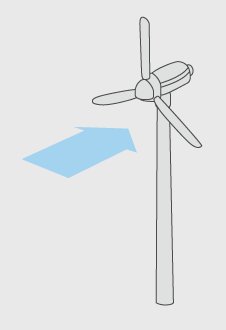
Horizontal axis wind turbines consist of a main rotor shaft held high and parallel to the ground and pointing towards the wind. It typically consists of two or three blades at one end of the shaft and a tail at the other end, which helps the turbine to orient itself against the wind.
Vertical axis wind turbines
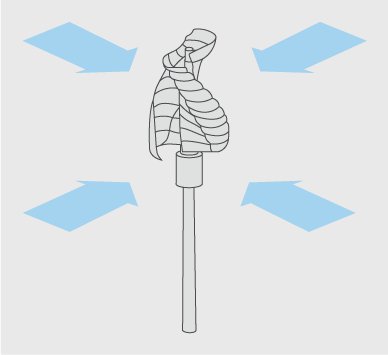
Vertical axis wind turbines consist of a main rotor shaft perpendicular to the ground. Unlike HAWT, VAWT need not point towards the direction of the wind and can operate with wind coming from all directions.
The basic components of wind turbine are as follows:
Small and medium scale wind turbines are generally classified as turbines with rated power of equal to or less than 100 kW. Although there is no standard definition available for a wide range of turbines, there is some acceptable international and Country specific terminology while referring to wind turbines of various capacities. Wind turbines are classified most of the time based on their rated power, although, height of installation, rotor swept area, feed in tariffs etc. are also used to sometimes define them.
| Country/Definition source | Classification | Rated Capacity (kWp) | Additional remarks |
|---|---|---|---|
| AWEA, USA | Small wind turbine | 1 – 100 | - |
| BWE, Germany | Small wind turbine | < 75 | - |
| CIEMAT, Spain | Pico wind | < 1 | Rotor swept area < 4.9 m2 |
| CIEMAT, Spain | Micro wind | 1 < 7 | Rotor swept area < 40 m2 |
| CIEMAT, Spain | Mini wind | 7 < 50 | Rotor swept area < 200 m2 |
| International Electro technical Commission | Small wind turbines | ≈ 50 | Rotor swept area < 200 m2 |
| Micro Generation Scheme (MCS), UK | Micro & Small wind turbine | < 50 | This classification is based on fed-in tariff as turbines with rated capacity less than 50 kW qualify fort the MCS feed-in tariff programme |
| NRCan & CanWEA, Canada | Mini wind turbine | 0.3 – 1 | - |
| NRCan & CanWEA, Canada | Small wind turbine | 1 – 30 | - |
| REEEP, China | Small wind turbine | 1 – 100 | Adopted in the recent National Policy, Strategy and Roadmap Study for China Small Wind Power Industry Development |
| RenewableUK, UK | Micro wind | 0 – 1.5 | 0.5 - 5 m Height / Up to 1,000 kWh Annual Energy Production |
| RenewableUK, UK | Small wind | 1.5 – 15 | 2 - 50 m Height / Up to 50,000 kWh Annual Energy Production |
| RenewableUK, UK | Small-medium wind | 15 – 100 | 50 - 250 m Height / Up to 200,000 kWh Annual Production |
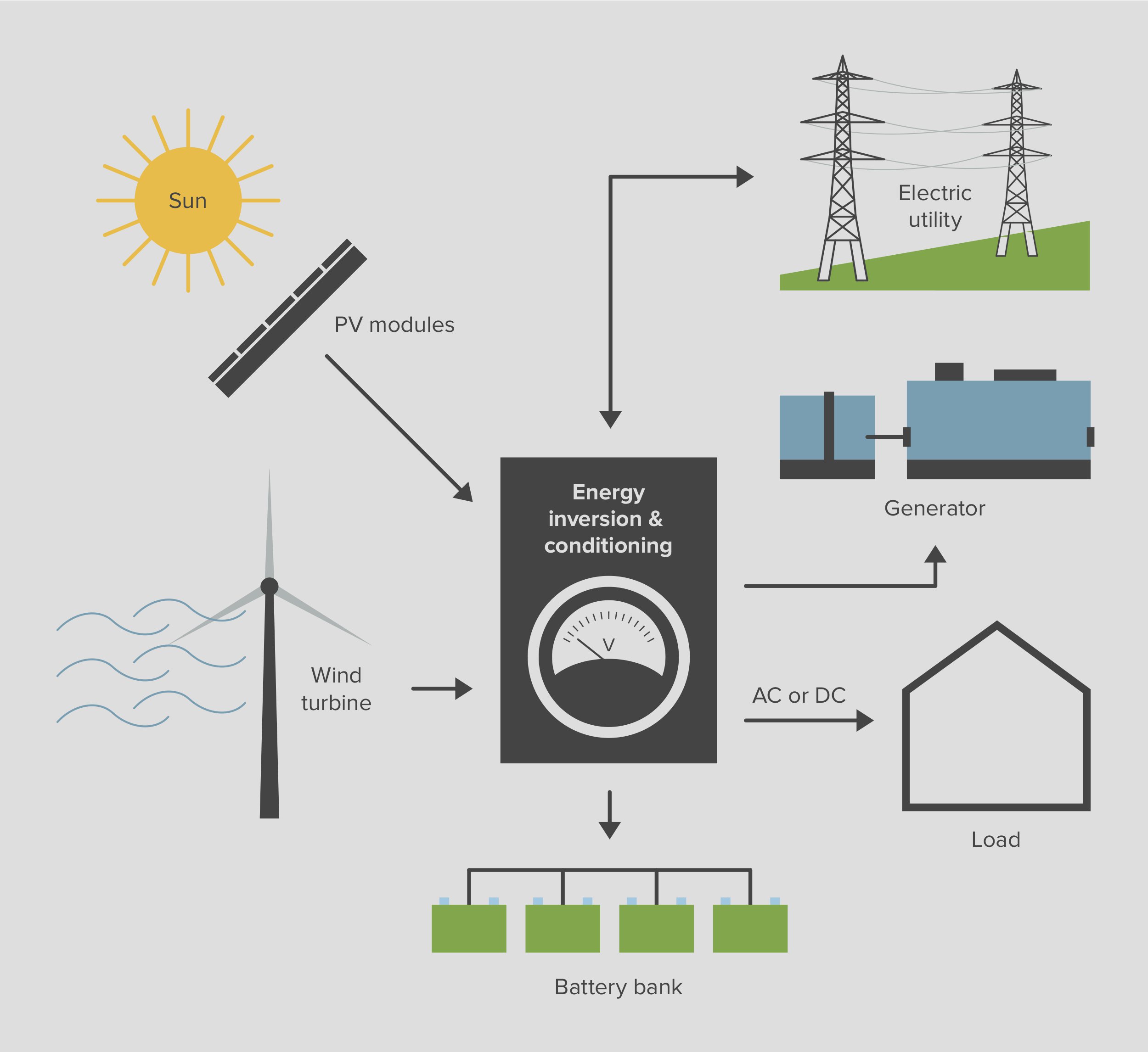
BUWTs can either be a grid connected or a stand-alone system or a hybrid one combining both the features. The configuration depends primarily on the purpose of the BUWT system and its capacity. A typical installation consists of the following components:
Sufficient space needs to be provided within the building to locate components other than the PV panels like battery bank, inverter etc.
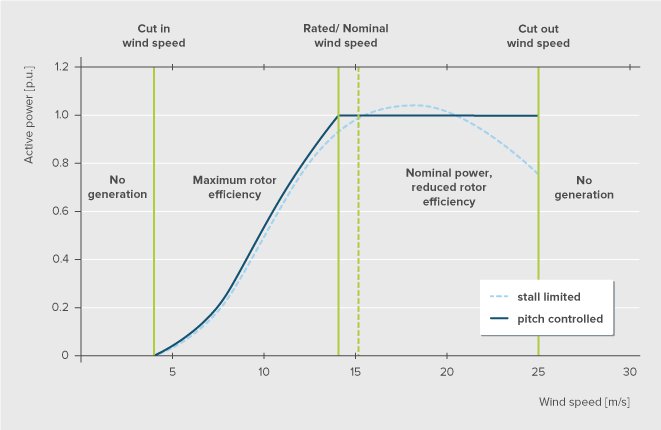
The efficiency of a wind turbine depends on its ability to transform most of the kinetic energy in the wind to usable electric energy. Wind speed can have a significant impact on the energy generation of a wind turbine. The following graph illustrates the power generation of a wind turbine at different wind speeds. Typically a wind turbine reaches peak power at a certain wind speed and the power generation capacity reduces as the wind speed increases above a critical value (see figure below).
Some key parameters that need to be understood while selecting a wind turbine are as follows.
Cut in speed: It denoted the minimum speed only beyond which a wind turbine starts generating energy. Usual cut-in speeds for BUWT are in the range of 3-5 m/s.
| Cut in speed | % |
|---|---|
| Have a cut-in wind speed < 3 m/s | 47 |
| Have a cut-in wind speed > 3 < 4 m/s | 38 |
| Have a cut-in wind speed > 4 | 14 |
Rated/Nominal wind speed: wind turbines are classified based on their rated power at certain wind speeds. For BUWTs it is generally between 5-15m/s and depends on the type of wind turbine and its rotor. A wind turbine operated most efficiently if the average wind velocity of a place is equal to the rated wind speed of a wind turbine.
| Rated/Nominal speed | % |
|---|---|
| Have a rated wind speed < 11 m/s | 26 |
| Have a rated wind speed > 11 < 13 m/s | 46 |
| Have a rated wind speed > 13 < 17 m/s | 21 |
| Have a rated wind speed > 17 | 7 |
Peak energy wind speed: The wind speed at which the wind turbine operates at its peak power generation capacity is called peak energy wind speed.
Cut out speed: The wind speed beyond which the power generation capacity of a turbine falls rapidly and causes damage to the turbine and rotor is called cut out speed. There will be no power generation beyond the cut out wind speed and the wind turbine effectively comes to a halt.
| Cut in speed | % |
|---|---|
| Have no cut-out wind speed | 54 |
| Have a cut-out wind speed > 20 m/s | 36 |
| Have a cut-out wind speed > 15 < 20 m/s | 7 |
| Have a cut-out wind speed > 10 < 15 m/s | 3 |
Different type of wind turbines based on control mechanism
Stall controlled (passive): At higher speeds beyond the rated wind speed of a wind stall controlled wind turbines reduce the torque on the rotor blades. Stall controlled turbines have the rotor blades bolted onto the hub at a fixed angle. The geometry of the rotor blade profile however is aerodynamically designed. As the wind speed becomes too high, it creates turbulence on the side of the rotor blade and this stall thus prevents the lifting force of the rotor blade from acting on the rotor.
Stall controlled (active): In active stall controlled turbines the rotor blades are actively controlled to induce stall. In other words, it will increase the angle of attack of the rotor blades in order to make the blades go into a deeper stall, thus wasting the excess energy in the wind.
Pitch controlled: Pitch controlled wind turbines have the pitch of the rotor blades adjust hydraulically according to the wind speed. At wind speeds of rated power and beyond this control enables the turbine to operate constantly at rated power and thus optimize the power generation.
Calculation of wind regime at the site of installation
Wind speeds for a given location can be represented through wind rose. Wind rose gives information regarding the frequency at which wind blows from specific direction through out the year. However, wind speeds in urban environment varies a lot from the measured meteorological average depending on the building’s surrounding urban environment, it’s height, orientation etc. Therefore, suitable site with reliable wind speeds is very much essential for a wind turbine to perform efficiently. Wind measurements for meteorological purposes are generally taken at 10 m height from the ground. However, wind speeds vary depending on the height from the ground and they are highly complex to determine in an urban environment.
It is highly recommended to have an experimental, analytical or computational validation of local wind speeds in and around the site selected for the mounting of wind turbines to ensure that their design and expected performance are consistent. With the advances in the field buildings are designed in such a way to design and incorporate wind turbines on the facades or between the buildings in an urban location. This requires meticulous calculation of the local wind velocity patterns. Modern day CFD tools made it possible to intelligently assess and design buildings identifying the ideal pockets for the installation of wind turbines. Though few buildings have experimented with integrating wind turbines in building façade and else where, rooftop installation of wind turbines dominates the market scene.
Analysing aesthetic, structural and noise implications of wind turbines
Aesthetic
appeal when integrated with buildings, and noise factor that arises due
to frequency resonance are also among the prime concerns limiting the
usage of building integrated wind energy systems that needs to be
addressed.
Selecting, design and optimizing wind turbine
Of
various available choices a careful selection has to be done to find a
product that highly suits depending on the building, its surroundings
and wind patterns.
Focusing on economics of wind turbine installation
Capital
cost of the wind turbine, its lifetime, operational efficiency,
prevailing utility rates etc., are the factors that need to be taken
into consideration to arrive at a workable payback period.
Energy generation, storage and transmission
Energy
generated through a wind turbine can either be used directly or stored
in a battery for later use or can be fed into the grid directly
depending on the purpose and the nature of the installation.
Building integrated wind turbines
When a building is designed to incorporate wind turbine within the main structure of the building itself it can be classified as building integrated wind turbine. The design, sizing and structure of such systems are custom built and could look different in each case.
Building rooftop mounted wind turbines
Most small scale VAWT and some specially designed HAWT are suitable for mounting on building rooftops. Some small turbines can be mounted on any type of flat/pitched roof while some turbines need special mounting requirements to take care of the structure, vibration damping, and rotor hub in case of VAWT.
Ground mounted nearby building
When all of the above cases are not possible for various reasons then the wind turbines can be mounted adjacent to the building. Care should be taken so that the building or it surroundings have minimum obstructions to the wind that impact the generation capacity of the wind turbine (see figure below).
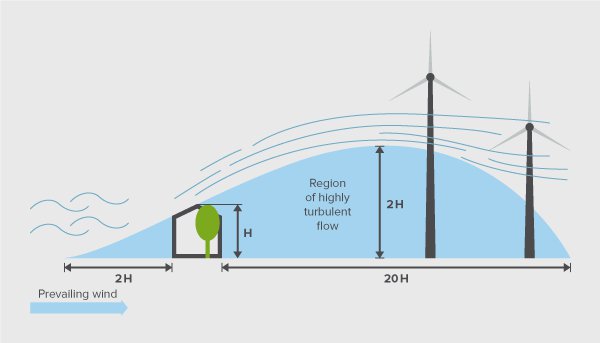
Installation of wind turbines requires expertise and has to take care of properly mounting and calibrating the system. The system integration with energy storage or grid or direct load has to be done carefully. The system needs regular maintenance and has to be checked for accumulation of dust or other elements on the rotor blades that may produce unwanted drag on the rotor. The system has to be checked for the proper functioning of controls and meters and needs to be recalibrated if inconsistencies are found.

makes energy efficiency in buildings and appliances transparent. For investors, policy-makers and actors involved in implementation and consultancy. Learn more ...




 Buildings Guide
  Policy Guide
  Appliances Guide
  India
India South Africa