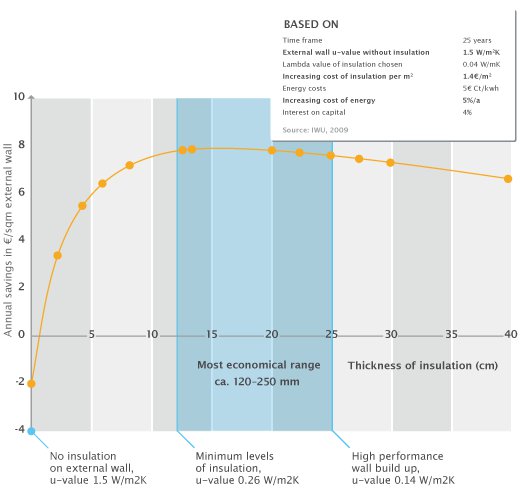
The above diagram shows the rate of return in relation to the thickness of applied insulation over a period of 25 years. If considering the mere cost of the material, as can be done in new buildings, the application of insulation is highly cost-effective. The economical optimum thickness of insulation currently ranges from 160 – 250mm, taking the minimum surface temperature of the internal wall into consideration. The rather ‘flat’ curve at the optimum also shows that in similar financial conditions, a further reduction in heat loss - by almost half - is also possible. Moreover, once the insulation is in place, it is very difficult to add extra thickness later on. It is thus always more economical to install insulation during initial construction or refurbishment rather than piecemeal.
Insulation lasts for at least 25 years if installed correctly. Energy prices, however, vary. Considering the rather low additional cost per m2 for an increase in insulation thickness of about EUR 1–1.4 for each 10 mm (IWU, 2012) added, it becomes a viable option to ‘future proof’ the building with substantially higher levels of insulation (up to 400 mm) and to increase the internal comfort level. Care should be taken to insulate all pipes and ducts outside of the building envelope to reduce heat loss/gain.

makes energy efficiency in buildings and appliances transparent. For investors, policy-makers and actors involved in implementation and consultancy. Learn more ...




 Buildings Guide
  Policy Guide
  Appliances Guide
  India
India South Africa